index
Part 2: Modern era
Chapter 3: Politicians
OZAKI Yukio, 1858-1954
A politician. After working as a journalist, he joined in establishing the Rikken Kaishin-to (Constitutional Reform Party). Since the first general election, he was elected 25 consecutive times (the largest number of all representatives), and he worked as a Diet member for 63 consecutive years (the longest of all representatives). He held positions including the mayor of Tokyo City and the Minister of Justice. He was called the "god of constitutional politics" since he led the movement to protect constitutional government.
88 Ozaki Yukio shokan, May 17, 1892 [Morimoto Kakuya Papers: 1]
This is a letter written by Ozaki to Morimoto Kakuya who was one of Ozaki's supporters in Mie, Ozaki's home town, and also was a prefectural assembly member. The letter describes the situation of the Imperial Diet. At the second election carried out in February 1892 under the first Matsukata Cabinet, the government greatly interfered with the popular parties. At the House of Representatives plenary session after the election, the popular parties pursued the government responsibility, and the Diet was adjourned. The letter says, "This issue is the first step in developing our constitutional government" and shows the inner feelings of Ozaki who resisted domain-clique government.
尾崎行雄書簡
尾崎行雄書簡
尾崎行雄書簡
GOTO Shinpei, 1857–1929
Goto was a bureaucrat and politician. After graduating from Sukagawa Medical School in Fukushima Prefecture, he served in successive roles as a physician at the Osaka Army Temporary Hospital, concurrently as director of Aichi Prefectural Hospital and head of Aichi Medical School, and then as a member of the Sanitary Affairs Bureau in the Home Ministry. In 1898, he was appointed director of the Civil Administration Bureau of the Office of the Governor-General of Taiwan, where he demonstrated his skill in colonial administration. He then held successive positions as the first president of the South Manchuria Railway Company, president of the Railway Department, and Minister of Foreign Affairs, among others. He served as mayor of Tokyo from 1920 for a little over two years, during which he announced an ambitious "800-million-yen plan" aimed at a major overhaul of the city's infrastructure. After the Great Kanto Earthquake, he became president of the Imperial City Restoration Department and drew up plans for Tokyo's reconstruction.
89 Goto Shinpei shokan, December 11, 1920 [ISHIGURO Tadanori Papers: 474]
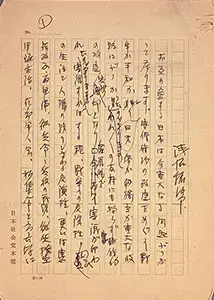
A reply letter addressed to Ishiguro Tadanori, the former head of the Army's military doctors and a benefactor of Goto who recognized Goto's ability in his youth. In this letter, Goto explains his initial refusal to accept the offer to become mayor of Tokyo, stating that he instead wished to devote himself to establishing a major research institute for economic and industrial reform. At that time, Tokyo was in turmoil: the previous mayor had resigned over a major bribery scandal, and the Tokyo City Council chose Goto as the new mayor, viewing him as a major figure who could wipe the slate clean and open a new chapter in city politics. When Goto declined, the city council launched a large-scale effort to enlist people to persuade him to change his mind, including luminaries from Shibusawa Eiichi to genro (elder statesman) Yamagata Aritomo and Prime Minister Hara. Barely a week after sending this letter to Ishiguro, Goto accepted and assumed the post of mayor.
後藤新平書簡(署名部分)
後藤新平書簡(署名部分)
ICHIKAWA Fusae, 1893-1981
Ichikawa was a women's movement activist and a politician. She was born in a farmer's family in Aichi Prefecture. After working as a journalist, she established the Shin Fujin Kyokai (New Women's Association) with Hiratsuka Raicho in 1919. She devoted herself to women's suffrage, and an election law recognizing women's suffrage (universal suffrage) was realized by the revision of the Election Law for Members of the House of Representatives in 1945. She became a member of the House of Councilors in 1953 and worked as a member for 5 terms (25 years).
90 Ichikawa Fusae shokan, January 30, 1930 [Shimomura Hiroshi Papers (No.1): 77]
This is a letter of appreciation written by Ichikawa, who was working hard for women's suffrage, to Shimomura Hiroshi, a senior managing director of the Asahi Shimbun newspaper company, who attended the discussion meeting held by the Fusen Kakutoku Domei (Women's Suffrage League). Looking towards the general election in the following month, Ichikawa and others were holding speech meetings in local cities and promoting the movement to revise the election law. In this letter, Ichikawa is asking Shimomura for support. The Fusen kakutoku domei kaiho (extra issue of the newsletter of the League) included in the letter has the description of the image of the ideal candidate and says the office has been incredibly busy since the dissolution of the Diet.
書簡に同封された会報
市川房枝書簡
書簡の封筒裏
SHIGEMITSU Mamoru, 1887–1957
Shigemitsu was a diplomat and politician. After graduating from the Law College of the Imperial University of Tokyo, he entered the Ministry of Foreign Affairs. In 1933, he became the Vice Minister of Foreign Affairs and successively served as ambassador to various countries, including the Soviet Union and the United Kingdom. He was the foreign minister in the Tojo and Koiso Cabinets. After WWII, he signed Japan's Instrument of Surrender as the foreign minister in the Higashikuni Cabinet. He was sentenced to seven years of imprisonment by the International Military Tribunal for the Far East and released on parole in 1950. After his purge from public office was lifted, he worked toward normalizing diplomatic relations with the Soviet Union as foreign minister in the Hatoyama Ichiro Cabinet, a move that contributed to Japan's admission to the United Nations.
91 Shigemitsu Mamoru kigo no nigaoe, June 1936 [MORI Motojiro Papers: 92]
A caricature drawn by Shigemitsu himself when journalist Mori Motojiro visited him while he was serving as Vice Minister of Foreign Affairs. "Shall I draw one for you?" Shigemitsu offered and picked up his brush, his brushstrokes humorously capturing Mori's angular features. Mori was a reporter in charge of covering the Foreign Ministry, and their personal relationship must have stemmed from exchanges of information at work. This drawing dates to June 1936, which was a hectic time for Shigemitsu with Manchukuo–Soviet border disputes and the February 26 incident. To call the caricature a spitting image is difficult when one compares it with a portrait photograph of Mori, but his air and presence certainly come through. According to a note Mori wrote on the reverse side, Shigemitsu boasted of his own skill at caricature.
重光葵揮毫の似顔絵
森元治郎写真
NAGAI Ryutaro, 1881-1944
A politician. After teaching colonial policy as a professor at Waseda University, he became a Member of the House of Representatives in 1920 and joined the Kenseikai (Constitutional Association). He devoted himself to establishing the Universal Manhood Suffrage Law. In 1931, he became the secretary general of the Rikken Minsei-to (Constitutional Democratic Party), and worked as the Minister of Colonial Affairs in the Saito Cabinet, the Minister of Communication in the Konoe Cabinet and the Minister of Railway in the Abe Cabinet. He is the founder of Japan Scholarship Foundation.
92 Nagai Ryutaro shokan, July 29, 1940 [Arima Yoriyasu Papers (No.1): 44-1]
This is a letter written to Arima Yoriyasu by Nagai who was known as an eloquent politician in the prewar period. In the s hintaisei movement (to establish a national political system) promoted by Arima and others with Konoe Fumimaro as the center, various parties resolved and joined the s hintaisei. On July 25 when the second Konoe Cabinet was formed, about 40 representatives including Nagai who were members of the Rikken Minsei-to and working for an early resolution of the party gave up on the party's executives and left the party. This letter is to tell Arima about the situation. When the Rikken Minsei-to dissolved on August 15, and the Taisei Yokusankai (the Imperial Rule Assistance Association) was established on October 12 with Konoe being the president, Arima became the secretary general, and Nagai became the Permanent Director General.
永井柳太郎書簡
ASANUMA Inejiro, 1898-1960
He was a social activist and a politician. After belonging to the Nomin Rodo-to (Farmer-Labor Party) and Nihon Rono-to (Japan Labor-Farmer Party), he became a member of the House of Representatives in 1936 when he belonged to the Shakai Taishu-to (Social Masses Party). After the war, he was engaged in establishing the Nihon Shakai-to (Japan Socialist Party) and became the secretary general in 1948. In 1960, he became the chairman of the party and stood at the front line of conflicts over the amendment of the Japan-U.S. Security Treaty inside and outside the House of Representatives. He was assassinated by a rightist in the same year while he was giving a speech at a party leader's speech meeting in the Hibiya Kokaido Hall. He was called a "human locomotive" because of his energetic activities.
93 Kokkai kaisan o yokyu suru enzetsu soko, June, 1960 [Asanuma Inejiro Papers (No.1): 2457]
This is Asanuma's autograph manuscript. The Kishi Cabinet signed the New Japan-U.S. Security Treaty on January 19, 1960 in order to remove the unequal character of the Japan-U.S. Security Treaty concluded in 1951, and to strengthen Japan to be more independent. In March of the same year, Asanuma became the chairman of the Nihon Shakai-to and stood at the front line of the conflict in and out of the House of Representatives to prevent conclusion of the new treaty. While deliberations stalled due to forcible passage at the House of Representatives in the early hours of May 20, the Daigishi-kai (representatives' meeting) of Nihon Shakai-to decided to resign en masse, and requested the withdrawal of the Kishi Cabinet as well as dissolution of the Diet. The inserted material shown is the manuscript of the speech given at that time.