index
Part 2: Modern era
Chapter 2: Past prime ministers 2. Postwar prime ministers
Prince Higashikuni Naruhiko, 1887-1990
He was a politician and the 43th Prime Minister. He formed the first cabinet comprised of Imperial family members on August 17, 1945, immediately after the war ended. He signed the Instrument of Surrender with the Allied Nations, called for the breakup of the army and navy. On the other hand, he resisted the Allies' policy and the Cabinet resigned with the shortest reign of 54 days. He changed his name to Higashikuni Naruhiko after he renounced his Imperial status in October 1947. He is known for saying at the press conference (August 28, 1945) after becoming Prime Minister, about "national confession of Japanese war guilt" as a first step of reconstruction and unity of the country.
84 Higashikuninomiya Naruhiko o shokan, ca. 1932 [Araki Sadao Papers: 21 ]
This is a letter written by Prince Higashikuni Naruhiko when he was an army major general to Araki Sadao who was the War Minister. In the letter, he is requesting to move him not to the General Staff Main Office but to the garrison for the independence of the South Manchuria Railway. This is thought to be due to his strong interest in the army's desire to occupy Manchuria and Mongolia. His attitude as a military man was supported by some in the army.
東久邇宮稔彦王書簡(2)
東久邇宮稔彦王書簡(1)
Trivia
The transition from writing brush to pen
The fountain pen was first imported to Japan in 1884. In those days, fountain pens did not have a modern split nib but rather a wire nib. It was not long, however, before the present form of the fountain pen came into use. One factor that contributed to the wide-spread use of the fountain pen was that, during the first Sino-Japanese War, they were supplied to military officers, because they were easier to handle than a writing brush on a warship. Additionally, as domestic production of western paper was growing more rapidly than that of washi (Japanese paper) in the 1890s and 1900s. The introduction of penmanship to the educational curriculum during the Taisho era also contributed to the transition away from the use of the writing brush on washi and the expanded use of the fountain pen on western paper.
Coincidentally, the modern ball-point pen with high-viscosity ink held in a tube-shaped reservoir was developed in Hungary in 1943.
SHIDEHARA Kijuro, 1872–1951
Shidehara was a diplomat and politician. He successively served as Vice Minister for Foreign Affairs, ambassador to the United States, and commissioner plenipotentiary to the Washington Naval Conference. From 1924 onward, he was Minister for Foreign affairs in the Kato (Takaaki), Wakatsuki, and Hamaguchi Cabinets, pursuing a policy of noninterference in China's domestic affairs and international cooperation. After the WWII, he became Japan's 44th prime minister in October 1945 after the Higashikuni Cabinet. During his term, he negotiated with the GHQ/SCAP (General Headquarters Supreme Commander for the Allied Powers) over issues such as the preservation of the imperial system and the drafting of Japan's new constitution. He was elected to the House of Representatives in 1947 and became Speaker of the House in 1949; however, he died in office in 1951.
85 Shidehara Kijuro shokan, 1 January, 1948 [ISHIBASHI Tanzan Papers: (No. 1)292]
A new year's letter addressed to Ishibashi Tanzan. Although Shidehara and Tanzan were acquaintances before WWII, their friendship deepened when both served as ministers in the first Yoshida Cabinet. In November 1947, Shidehara opposed the Temporary State Control of Coal-Mining Law proposed by the shakai-to (Japan Socialist Party) Katayama Cabinet; he withdrew from the Minshu-to (Democratic Party), which had been in coalition with the shakai-to and formed the Doshikurabu (a parliamentary group). In the letter, Shidehara appeals to Tanzan to understand that his actions were motivated solely by a desire for political stability, stating that "the situation no longer allows for any retreat." Later, Shidehara joined forces with Yoshida Shigeru's Jiyu-to (Liberal Party) to help form the Minshu Jiyu-to (Democratic Liberal Party). At that time, Tanzan was being purged from public office by the Allied administration, and traces of GHQ censorship remain on the envelope.
幣原喜重郎書簡
幣原喜重郎書簡
(封筒)
→See the other autograph material by Shidehara Kijuro (Material 177)
YOSHIDA Shigeru, 1878-1967
Yoshida was a politician. He was the 45th, 48th, 49th, 50th and 51st Prime Minister. He was a son-in-law of Makino Nobuaki who was a diplomat and a politician. He worked as a Vice Minister of Foreign Affairs, Ambassador to Italy and to the United Kingdom, Minister of Foreign Affairs in the Cabinet of Prince Higashikuni and the Shidehara Cabinet. After forming his first cabinet in 1946, he became the Prime Minister for a total of five times. He concluded the San Francisco Peace Treaty and the Japan-U.S. Security Treaty. He was known for his authoritarian behavior with great power even after his resignation from politics.
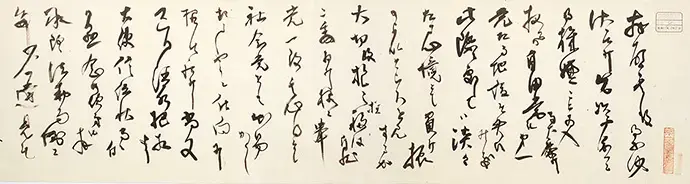
86 Yoshida Shigeru shokan, May 3, 1947 [Makino Nobuaki Papers, Letters: 659-54 ]
This is a letter from Yoshida who was a Prime Minister and the leader of the Jiyu-to (Liberal Party) to Makino Nobuaki who was his father-in-law. Prior to the entry into force of the new Constitution on May 3, 1947, the first House of Councillors election was held on April 20, and the second House of Representatives election after the war was held on April 25 in order to form the first Diet. In the House of Representatives election, no party was able to win a majority. Nihon Shakai-to (Japan Socialist Party) of Japan, which became the first party, elected Katayama Tetsu as its head and organized a coalition cabinet with the Minshu-to (Democratic Party) of Japan and the Kokumin Kyodo-to (National Cooperative Party). After the election, Yoshida, who decided to hand over the reins of government said, "It is important to leave in a matter-of-fact way." expressing himself ready to leave so that the Nihon Shakai-to would be able to take over without problem.
→See the other autograph material by Yoshida Shigeru (Material 177)
HATOYAMA Ichiro, 1883-1959
Hatoyama was a politician, and the 52nd, 53rd and 54th Prime Minister. He became a city council member of the Tokyo City Assembly and a member of the House of Representatives, and became Minister of Education under the Inukai Cabinet and the Saito Cabinet. After the war, he formed the Nihon Jiyu-to (Japan Liberal Party) and became its president, but was purged from public service immediately before the cabinet formation in 1946. After returning to the Diet, he formed a cabinet as the president of the Nihon Minshu-to (Japan Democratic Party). The Jiyu Minshu-to (Liberal Democratic Party) was formed during his service and he became its first president. In 1956, he signed the Soviet-Japanese Joint Declaration of 1956 and restored diplomatic ties.
87 Hatoyama Ichiro shokan, September 2, 1940 [Ando Masazumi Papers: 571-4 ]
This is a letter written by Hatoyama to Ando Masazumi. It was written when the movement of the shintaisei (the national political system) Preparatory Committee was being monitored with the establishment of the Taisei Yokusankai (the Imperial Rule Assistance Association) expected in October 1940. Ando was a politician who worked as the Secretary-General of the Rikken Seiyukai (the Friends of Constitutional Government Party), but he did not join the Taisei Yokusankai, and he ran the election with no endorsement along with Hatoyama in the Yokusan Senkyo (the general election of 1942) and was elected. In this letter, Hatoyama praises Ando for opposing the new administration and said, "You have restored your reputation. You are quite a man". But he also said, "The time will come." and tells him it is also necessary to have self-control. Hatoyama himself lived a life of a recluse in Karuizawa for several years until the war ended.
鳩山一郎書簡
鳩山一郎書簡
鳩山一郎書簡