index
Part 2: Modern era
Chapter 1: People at the end of the Edo period and the Meiji Restoration 1. People who lived through the end of the Edo period
SAKUMA Shozan (Zozan), 1811–1864
His given name was Hiraki or Taisei, and he adopted the pseudonym Shozan. He was born in Matsushiro Domain in Shinano Province into a lower-ranking samurai family. His wife was Junko, the younger sister of Katsu Kaishu. He was a devoted follower of Neo-Confucianism and studied under Sato Issai. Ordered by the eighth-generation lord of his domain, Sanada Yukitsura, to gather information on foreign affairs, he came to recognize the importance of Dutch studies and artillery technology upon studying the First Opium War. He also advocated for the adoption of Western science and technology. In 1854, he was implicated in the illegal attempted overseas voyage of his disciple, Yoshida Shoin and was placed under house arrest in his hometown of Matsushiro. Upon being acquitted in 1864, he went to Kyoto on the orders of the Shogunate and persuaded Hitotsubashi Yoshinobu and others to pursue kobu Gattai (reconciliation between the Shogunate and imperial court) and to open Japan to the rest of the world. However, he was assassinated by the followers of the sonno-joi group (lit. supporters of the doctrine of reviving the Emperor and expelling the barbarians). His writings include Seikenroku.
48 Sakuma Shozan Shinkan [February 18 of some year between 1854 to 1862] [WA47-14]
A letter written by Shozan to Takemura Kyoson, and a poet and uma bugyo (magistrate of horses) in the Matsushiro Domain. After writing his thoughts on the poem that Kyoson sent to him, Shozan advised him on the impropriety of composing poetry while mourning the death of one's mother, thereby offering insight into Shozan's devotion to Neo-Confucian principles. This letter is thought to be written during his house arrest in Matsushiro from 1854 to 1862, as inferred from expressions such as "I have been shut in my room for a long time." Both men were students of Confucian scholar Kamahara Tozan in the Matsushiro Domain. They were close friends who not only exchanged Chinese prose and poetry with each other but also often made excursions on horseback together.
佐久間象山真翰(部分)
II Naosuke, 1815–1860
Ii was a lord of the Hikone Domain, holding the court title kamon no kami. In April 1858, he was appointed tairo (chief minister) of the Shogunate. Without imperial sanction, he signed the Treaty of Amity and Commerce between Japan and the United States, which pushed Japan toward opening up to the rest of the world. He backed Tokugawa Yoshitomi (later Tokugawa Iemochi) as the 14th-generation successor to the Shogunate, going up against the faction backing Hitotsubashi Yoshinobu. During that struggle, he launched a major crackdown on isolationist elements, ordering the house arrests of daimyos (feudal lords) and court nobles and sentencing Yoshida Shoin and others to death (The Ansei Purge). In March 1860, he was assassinated by roshi (masterless samurai) from the Mito Domain outside Sakuradamon (Sakurada gate) of Edo castle.
49 Ii Naosuke shokan, June 29, 1858 [Sanjo Family Papers (Letters) 97-7]
A reply letter from Ii Naosuke in Edo to former Lord Keeper of the Privy Seal Sanjo Sanetsumu. Naosuke expresses his thanks for Sanetsumu's congratulations on his appointment as tairo (chief minister) and explains that the signing of the Treaty of Amity and Commerce between Japan and the United States on the 19th of the same month was undertaken out of necessity. According to Naosuke, Japan had little room for maneuver in foreign affairs given its pressing domestic difficulties; thus, the country would face a grave crisis should it suffer the same fate and repeat the mistakes as Qing China, which had been defeated in the Second Opium War. Sanetsumu clashed with Naosuke over the conclusion of the treaty and later that same year was implicated in the Ansei Purge, after which he was forced to become a monk.
YOSHIDA Shoin, 1830-1859
A thinker and educator at the end of the Edo period. A feudal retainer of the Choshu Domain. He requested permission to accompany the naval squadron commanded by Commodore Matthew Calbraith Perry anchored at Shimoda in 1854, but was refused. He turned himself in and was imprisoned. After his release from prison in 1855, he was placed under house arrest at the family home, where he founded and taught at the Shoka Sonjuku, a private school. There, he trained many patriots, such as Kusaka Genzui, Takasugi Shinsaku, Ito Hirobumi, and Yamagata Aritomo. In December 1858, he was again imprisoned in Noyamagoku prison and was executed during the Ansei Purge in the following year.
50 Yoshida Shoin shokan, March, 1859 [Inoue Kaoru Papers: 634-2]
This letter was written by Shoin to those who were close to Shoin (Kijima Matabee, Odamura Inosuke, Katsura Kogoro (later Kido Takayoshi), Kubo Seitaro) while he was imprisoned in Noyamagoku prison for his radical remarks and deeds concerning the Treaty of Amity and Commerce between the United States and Japan. He expresses himself on how he was ready to be executed and writes about his beloved student, Irie Kuichi (a.k.a. Sugizo), who was imprisoned due to failure in the operation to carry out the Doctrine of expelling foreigners directed by Shoin. While he expresses his discontentment with Irie, who keeps asking for release to take care of his aged mother even in such a national emergency, he tries to understand him.
51 Yoshida Shoin shokan, March 29, 1859 [NOMURA Yasushi Papers: 20-1-12]
A letter written by Shoin from prison to his brother-in-law Odamura Inosuke and to several disciples including Kusaka Genzui. At this time, Shoin had been imprisoned again for his radical remarks condemning the Shogunate's signing of the Treaty of Amity and Commerce with the United States. At this point, Shoin also ceased communication with Inosuke as well as with his other disciples. Shoin's reasoning was that the other disciples had turned their backs on Irie Kuichi and Nomura Wasaku (Yasushi), two brothers who were also disciples of Shoin and had been imprisoned. The brothers were imprisoned because they alone had acted on Shoin's instructions, while the other disciples distanced themselves from Shoin. According to Shoin, it was only natural for him to cease communication with those disciples who had forsaken the two brothers.
吉田松陰書簡(3)
吉田松陰書簡(2)
吉田松陰書簡(1)
Trivia
Continuing a handwritten letter in the margin at the top
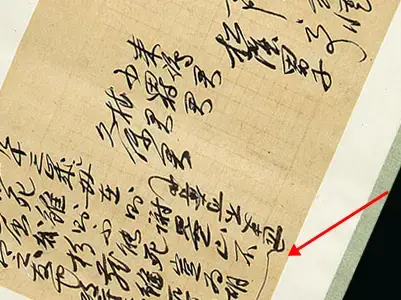
In olden times, people often used the margins at the top of a letter to continue writing on the same sheet of paper rather than using a second sheet, and this practice is known as kaeshigaki (e.g., Shimoda Utako. Of course, this assumes that a margin had been left at the top of the letter in the first place. In cases where even more space was needed, sometimes kaeshigaki continued into the space between earlier lines of text (e.g., Hosokawa Gracia).
Yoshida Shoin's letters show that he added postscripts in available space, but written upside down relative to the body of the text. This might be considered one form of kaeshigaki.
SAKAMOTO Ryoma, 1835-1867
A patriot at the end of the Edo period. His real given name was Naonari but his popular name was Ryoma. He was born in Tosa. After he left his domain and wandered through the provinces, he became a student of Katsu Kaishu in Edo and had his eyes opened for the opening of Japan to foreign countries. While he formed Kameyama-shachu (later Kaientai) and operated a trading business, he mediated between Saigo Takamori and Kido Takayoshi to enact the Satsuma-Choshu Alliance and realized taisei hokan (return of power to the Emperor), but was assassinated at Oumiya in Kyoto together with Nakaoka Shintaro.
52 Sakamoto Ryoma shokan, October 22, 1867 [MUTSU Munemitsu Papers: 51-9]
A letter written by Ryoma to his comrade Mutsu Munemitsu (who would later become foreign minister) concerning business transactions within the Kaientai). The letter is analogous to a present-day company memo. Ryoma informs Munemitsu of potential trade negotiations with the Sendai Domain and asks him to consider returning to Kyoto from Osaka. Ryoma writes that he entrusts Munemitsu with all business matters, thus showing how deeply he admired Munemitsu's business acumen and the complete confidence he placed in him.
坂本龍馬書簡(冒頭)
坂本龍馬書簡(冒頭)
末尾(署名部分)
53 Shin seifu koryo hassaku (from Boyucho), November, 1867 [Ishida Eikichi Papers: 1-5]
Suggested regime of the new nation drafted by Ryoma based on "Senchu Hassaku"and was shown to representatives of the Tosa Domain. "Senchu Hassaku" was said to have been created by Goto Shojiro, a feudal retainer of the Tosa Domain, with Ryoma in 1867 when Goto suggested taisei hokan (return of power to the Emperor) to Yamauchi Yodo, the former lord of the domain. It included a proposal for taisei hokan, parliamentary system, bureaucracy, diplomacy, selection of the constitution and military administration which formed the foundation the new Meiji government. The petition for taisei hokan submitted from the Tosa Domain to the Shogunate in October of the same year was created based on this "Senchu Hassaku ".
NAKAOKA Shintaro, 1838-1867
A patriot at the end of the Edo period. He was born in Tosa. He joined to form Tosa Kinno-to, but being suppressed by the Tosa Domain, he left the domain and devoted himself to the conclusion of the Satsuma-Choshu Alliance with Sakamoto Ryoma. Later he was pardoned for the sin of fleeing from the domain and formed Rikuentai which followed Ryoma's Kaientai, and became a captain. But he was assassinated at Oumiya with Ryoma.
54 Nakaoka Shintaro hisseki (from Boyucho), January, 1867 [Ishida Eikichi Papers: 1-15]
Nakaoka Shintaro went to Dazaifu in January 1867 and informed the death of Emperor Komei to Sanjo Sanetomi, Sanjonishi Suetomo, Higashikuze Michitomi, Shijo Takauta and Mibu Motonaga. Seven nobles were expelled from Kyoto in the Coup of August 18th, 1863, but these five nobles were in Dazaifu at that time. It is the shichigon zekku (a Chinese poem of four lines, each of seven characters) Nakaoka read at that time.
亡友帖 中岡慎太郎筆跡
TAKASUGI Shinsaku, 1839-1867
A patriot at the end of the Edo period. He was born in Choshu. He studied at Shoka Sonjuku (a private school) and joined sonno-joi undo (lit. movement to revere the Emperor and expel the barbarians) and took part in the fire attack on the British legation. In 1863, he established the Kiheitai army to defend Shimonoseki, and repelled the Shogunate force at the Second Choshu Expedition, but died of illness before the Meiji Restoration.
55 Takasugi Shinsaku shokan (from Boyucho), [ca. 1865] [Ishida Eikichi Papers: 1-7]
Since it has the signature "Tani", it was probably written after his name was changed to "Tani Senzo" at the domain's order in September 1865. He apologizes to Ishida, who was of Takasugi's age, for "being indignant in discussion" and said, "I apologize for being short-tempered due to my illness".
Column Boyucho
This is a scroll made by Ishida Eikichi with 19 writings including letters and manuscripts of kanshi (Chinese poems) written by Ishida's 15 friends including Takeda Kounsai, Kido Takayoshi, Sakamoto Ryoma, Nakaoka Shintaro, Takasugi Shinsaku.
Ishida was born in Tosa and was a patriot who was active in kinno undo (movement to revere the Emperor). He joined the Tenchu-gumi, and later he joined the Kiheitai Army and Kaientai, and took part in the Boshin War. He served the new government after the Meiji Restoration and became the Vice Minister of the Ministry of Agriculture and Commerce, the governor of Kochi Prefecture. He was created a Baron in 1896 and became a member of the House of Peers.
Although it is not clear what motivated Ishida to collect these materials and make this scroll, it is assumed that the research he carried out during his tenure as a governor of Kochi Prefecture in 1893, by special order of the Home Ministry on those who had rendered distinguished services for the Restoration, had affected him. Also in 1897, he devoted himself to building a monument to 23 patriots of the Tosa Kinno-to who were executed on September 5, 1864. At that time, Ishida was collecting materials on the 23 patriots and wrote a reminiscent talk about them, being active in telling people about his comrades and their achievements during their lifetimes.
In the 1880s, when society was getting settled, not only Ishida but also vassals of the former Shogunate and those who were engaged in domain offices started listening, writing and remembering about the movement at the end of the Edo period and the Meiji Restoration.
Ishida's documents (Ishida Eikichi Papers) include records such as "Kainan junnanshi ryakuden" which is about the said 23 patriots and "Yamato nikki", material concerning Tenchu-gumi which show Ishida's desire to pass on the great achievements of the patriots during the Restoration.
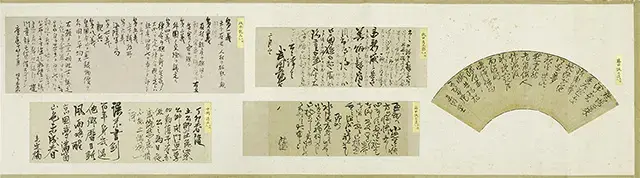
<Other people whose writings were included in Boyucho >
FUJITA Toko
TAKEDA Kounsai 1803-1865
A feudal retainaer of the Mito Domain at the end of the Edo period. He played an active role as a reformist of the Mito Domain, and became a leader of the Tengu-to, a radical sonno-joi group (lit. supporters of the doctrine of revering the Emperor and expelling the barbarians). He attempted to go to Kyoto but surrendered to the Kanazawa Domain and was executed.
Kido Takayoshi
TAKAMATSU Tsurukichi 1807-1876
Confucian scholar at the end of the Edo period. He opened a private school in Tosa and produced Nakaoka Shintaro, Ishida Eikichi and others. He married Chizuru, Sakamoto Ryoma's elder sister. His eldest son succeeded as the head of the Sakamoto Family, and his second son succeeded to Ryoma's Family.
MASAKI Tetsuma 1834-1863
A feudal retainaer of the Tosa Domain at the end of the Edo period. He joined Tosa Kinno-to and worked for reform of domain politics, but aroused the anger of Yamauchi Yodo, the former lord of the domain, and was ordered to commit suicide by falling on his sword.
OYAMA Tsunayoshi, 1825-1877
A feudal retainaer of the Satsuma Domain at the end of the Edo period, and a bureaucrat. He took a central role in the purge of radical retainers in the Teradaya Incident. After the Restoration, he supported Saigo Takamori at the Satsuma Rebellion while he was a prefectural governor, and was executed.
KADOTA Tamenosuke, 1838-1867
A feudal retainaer of the Tosa Domain at the end of the Edo period. He joined Tosa Kinno-to and was acquainted with Sakamoto Ryoma as a student of Katsu Kaishu.
KAWAKAMI Gensai, 1834-1872
A feudal retainer of the Kumamoto Domain at the end of the Edo period. He was called "Hitokiri Gensai" for what he did after he joined sonno-joi group (lit. supporters of the doctrine of revering the Emperor and expelling the barbarians) including assassinating Sakuma Shozan. He was arrested on suspicion of forming a plot against the government in 1870, and was executed.
YOSHIGA Makita, 1844-1868
He was from the Choshu Domain. He went to Echigo in the Boshin War but died of illness.
DATE Chihiro, 1802-1877
A feudal retainer of the Wakayama Domain at the end of the Edo period, a scholar of Japanese classical literature and a poet. He is famous for his history book, Taisei Santenko. He was the father of Mutsu Munemitsu.
HASEGAWA Tetsunoshin, 1822-1871
A patriot of the sonno-joi group (lit. the supporters of the doctrine of revering the Emperor and expelling the barbarians) at the end of the Edo period. He was from Echigo Province. He fought in the Kinmon Incident and the Boshin War.
DAIRAKU Gentaro, 1834-1871
A feudal retainer in the Choshu Domain at the end of the Edo period. He promoted sonno-joi undo (lit. movement to revere the Emperor and expel the barbarians) with Takasugi Shinsaku and others andstarted a private school, Seizan Shoya. After the Restoration, he was implicated in the assassination attempt of Omura Masujiro and was confined. He escaped later but was assassinated in 1871 in Kurume where he was hiding.