index
Part 2: Modern era
Chapter 1: People at the end of the Edo period and the Meiji Restoration 3. Vassals of the Shogun and FUKUZAWA Yukichi
OTORI Keisuke, 1833-1911
A soldier at the end of the Edo period and in the Meiji era. A diplomat. He learned Dutch studies and Western military science and became an executive of the Shogunate army. In the Boshin War, he went to Hokkaido with Enomoto Takeaki, but surrendered in the Battle of Goryokaku. Later he was picked by the Meiji government and held positions such as the head of Kobu Daigakko (the Engineering Grand School) and the Japanese Minister in Qing.
67 Ryuraku nikki, May 18-June 30, 1869 [Otori Keisuke Papers: 1]
In 1869, seven people including Enomoto Takeaki and Otori Keisuke who surrendered in the Battle of Goryokaku were sent to Tokyo and imprisoned. This is a diary written by Otori during his transfer starting from Goryokaku on May 18 to Senju on June 29. It is a simple diary basically with dates, weather and places they stayed. Some days have places they ate lunch and the distance they moved. It also includes how their stopping places were affected by the Boshin War, showing his military sense.
流落日記(5月18日 五稜郭開城)
流落日記(表紙)
Trivia
An early example of a portable writing kit
Looking at the Material 67 (Otori Keisuke), you might wonder how this travel diary was written during an age when writing instruments were actually quite cumbersome. In fact, ancient travelers had used portable writing kits, called yatate, since the 13th century in Japan. Yatate were a kind of portable case that held a small writing brush and an inkpot, in which a little cotton was often used to hold the ink. During the Edo period, as commercial activities grew, a yatate was an essential item for travelling merchants, and their use remained widespread until the modern era.
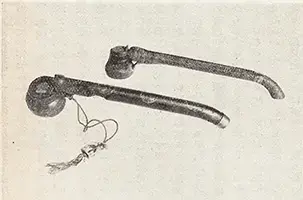
Shizen kagaku to hakubutsukan, 4(9)(45), National Museum of Nature and Science,Tokyo,1933.9 [Z14-213]
KATSU Kaishu, 1823-1899
A vassal of the Shogun at the end of the Edo period and a politician in the Meiji era. He changed his name to Yasuyoshi after the Meiji Restoration. He studied seamanship and navigation at Kaigun Denshu-jo (Japanese Naval School in Nagasaki), sailed across the Pacific Ocean as the captain of the Kanrin Maru, and went to the United States. When he returned to Japan, he devoted himself to developing the Shogunate navy. In the Boshin War, he met with Saigo Takamori as the representative of the Shogunate and realized the bloodless surrender of Edo Castle. After the Meiji Restoration, he served in various positions, such as sangi (councilor) and kaigunkyo (Navy Minister), and also worked to help vassals of the Shogun rebuild their lives.
68 Kaishu jigasan [Katsu Kaishu Papers: 43]
Katsu's self-portrait with his own san (poem or sentences added to the work). His san says, "I do not care about small things. I can be a general, and I can be a common soldier. I will be sangi (councilor) at the Imperial Court, and I will be an ordinary person when out of power. Whichever situation I am in, I will take it as it is and see the situation". It seems to be written when he was out of power but it is not clear when it was written.
69 Katsu Kaishu sho [SUGIURA Yuzuru Papers: 763]
→See the column "Sanshu (three Shu-s) at the end of the Edo period"
→See also the other autograph material by Katsu Kaishu (Material 188)
TAKAHASHI Deishu, 1835–1903
A vassal of the Shogun, Deishu was the second son of hatamoto (direct vassal of the Shogunate) Yamaoka Masanari and was later adopted into the Takahashi family. His brother-in-law was Yamaoka Tesshu (the husband of his younger sister). He was renowned for his mastery with the spear and served as an instructor of spear fighting at the Kobusho (martial arts school). After the battle of Toba–Fushimi in January 1868, he persuaded Tokugawa Yoshinobu to submit to the New Government Army. When Yoshinobu left Edo castle in February for Kan'eiji temple in Ueno, Deishu acted as his bodyguard. Shortly after the Meiji Restoration, Deishu retired in seclusion and spent his remaining years enjoying calligraphy.
70 Takahashi Deishu sho [SUGIURA Yuzuru Papers: 764]
→See the column "Sanshu (three Shu-s) at the end of the Edo period"
YAMAOKA Tesshu, 1836–1888
A vassal of the Shogun, swordsman, and bureaucrat. Born into a family of a hatamoto (direct vassal of the Shogunate), he taught swordsmanship at the Kobusho. During the Boshin War, he traveled to Sunpu as an envoy of Katsu Kaishu and successfully persuaded Saigo Takamori to hold talks with Katsu. After the Meiji Restoration, he served as a chamberlain to Emperor Meiji, among other posts, while also opening a fencing dojo and founding the Itto shoden muto-ryu school of swordsmanship. He was the brother-in-law of Takahashi Deishu.
71 Yamaoka Tesshu sho [SUGIURA Yuzuru Papers 765]
→See the column "Sanshu (three Shu-s) at the end of the Edo period"
Column Sanshu (three Shu-s) at the end of the Edo period
Katsu Kaishu, Takahashi Deishu, and Yamaoka Tesshu are collectively known as the "Three Shu-s at the end of the Edo period" because their names share the same final character shu (meaning ship).
The origin and date of this term are unclear, but some books from the late Meiji era provide explanations on what the Three Shu-s are (Reference: Sanshu hiketsu: Tesshu, Kaishu, and Deishu). All three men served the Tokugawa family and were credited with securing the bloodless surrender of Edo castle. During preparations for negotiations between Saigo Takamori of the New Government Army and Katsu as the Shogunate representative, Takahashi recommended that his brother-in-law, Yamaoka, serve as Katsu's envoy and formally request Saigo to open negotiations. Yamaoka then traveled to Sunpu (present-day Shizuoka city) and successfully persuaded Saigo to participate in the negotiations. Katsu and Saigo ultimately negotiated and agreed to the peaceful handover of Edo castle.
A similar expression is Meiji ishin no sanketsu ("the three great leaders of the Meiji Restoration"), which refers to Saigo Takamori, Okubo Toshimichi, and Kido Takayoshi, given their contributions to the Meiji Restoration. Indeed, this expression contrasts with the three Shu-s in terms of the historical perspective one takes; these three leaders brought about the end of the Shogunate, from the perspective of the Shogunate, the three Shu-s take center stage.
The handwritten manuscripts of Katsu Kaishu (right side), Takahashi Deishu (center), and Yamaoka Tesshu (left side) were passed down in the family of Sugiura Yuzuru, a vassal of the Shogun and a contemporary of Takahashi and Yamaoka. Sugiura accompanied Japan's delegation to the Paris International Exposition during the end of the Edo period and went on to serve as a bureaucrat after the Meiji Restoration.
71 山岡鉄舟書
70 高橋泥舟書
69 勝海舟書
ENOMOTO Takeaki, 1836-1908
A soldier at the end of the Edo period and in the Meiji era, and also a politician. After he studied seamanship and navigation under Katsu Kaishu at the Navy Officer Training School in Nagasaki, he went to the Netherlands to study natural science and law. He returned to Japan in the completed Kaiyo Maru, and became Vice President of the naval force of the Shogunate. In the Boshin War, he barricaded himself in Goryokaku of Hakodate City and fought with the New Government army but surrendered. He was granted a special pardon and held various positions of minister in the new government. He also played an active role when designated as the Japanese minister in Russia and concluded the Treaty of Saint Petersburg (Sakhalin-Chishima Exchange Treaty).
72 Shiberiya nikki ko, 1878 [Enomoto Takeaki Papers: 8]
Diary written by Enomoto while he was crossing Siberia. He was dispatched to Russia to solve the Northern territories problem as envoy extraordinary, and concluded the Treaty of Saint Petersburg (Sakhalin-Chishima Exchange Treaty) in May 1875. He stayed in Russia and became the first Japanese minister in Russia. In 1878, he crossed Siberia using trains and carriages and returned to Japan. This diary is a record of 66 days of his trip. He wrote about various subjects including geography, climate, plants, politics and economy. On July 26, the day of his departure, he described how the ticket was handed to him and that he opened the bottle of Japanese sake he reserved in the train but did not like the taste.
FUKUZAWA Yukichi, 1834-1901
An enlightenment thinker and an educator in the Meiji era. He learned Dutch studies from Ogata Koan in Osaka and established a Dutch studies school (later Keiogijuku). He studied English by himself and went to Europe and the Americas three times including the time he accompanied the Shogunate's delegates in the Kanrin Maru. After the Meiji Restoration, he was engaged in the education and enlightenment campaign. He published Jiji shinpo and wrote Seiyo jijo (lit. Conditions in the West), Gakumon no susume (An encouragement of learning), Fuku-o jiden (The autobiography of Fukuzawa Yukichi) and others.
73 Fukuzawa Yukichi shokan, February 5, 1892 [Enomoto Takeaki Papers: 25-5]
This letter was written by Fukuzawa to Enomoto Takeaki. In the letter, Fukuzawa was asking Enomoto to check if the contents of the draft for Yasegaman no setsu (refer to the column) sent on 27 of the previous month is true because he is planning to publish it at the right time. Enomoto, who was a Minister of Foreign Affairs at that time, wrote back and only said "I am busy now so I will give you my opinion some time". Katsu Kaishu was asked the same question and he wrote back and said, "My course of action is my business and no one else's. Others may take it as they like. It does not matter to me and I do not care".
福沢諭吉書簡
Column Yasegaman no setsu by FUKUZAWA Yukichi
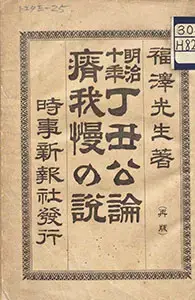
Yasegaman no setsu was written by Fukuzawa Yukichi around the winter of 1891. In this column, he was criticizing Katsu Kaishu and Enomoto Takeaki who used to be vassals of the Shogun but served the new government and were promoted to high positions. Fukuzawa sent this draft to Katsu and Enomoto in January 1892 and asking for their response (the Material 73 is a request for Enomoto to respond). In the letter, Fukuzawa commented on Katsu who realized the bloodless surrender of Edo Castle without fighting with government army (later Meiji government) and said "You have depreciated the importance of yase-gaman (fake stoicism) which is unique to the Japanese people and led to lowering of the morale that is indispensable for our country to keep on going. It cannot be overlooked". He criticized Katsu for having a position with honor and profit provided by the Meiji government after the Restoration as if he deserved it.
Also about Enomoto, he evaluated highly his raising an army against the government army in Hakodate and his spirit of samurai, which is yasegaman, but he said he cannot agree with the fact he assumed an important position in the Meiji government after he was released.
About ten years later, during the New Year of 1901, Yasegaman no setsu was published in Jiji shinpo. In May of the same year, it was combined with "Teichu koron" into one book and was published by Jiji Shinposha (Meiji 10nen Teichu koron Yasegaman no setsu [304-H826m]).