Bridges in Art: Meikyo (Famous Bridges), Kikyo (Unusual Bridges) and Kokyo (Historic Bridges)
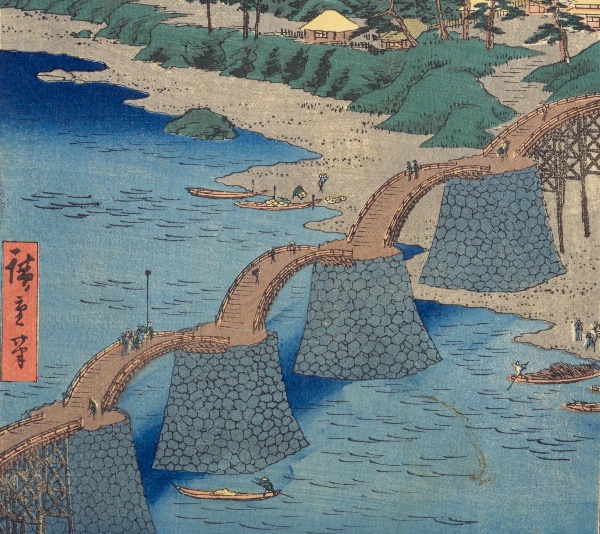
Bridges have long been built at key transportation hubs, supporting the movement of people and goods, and contributing to the growth of towns and cities around them. Among these, historically significant bridges and uniquely designed bridges have become well-known landmarks and beloved scenic spots. In Japan, there is a culture of appreciating beautiful landscapes, as seen in the Omi Hakkei (Eight Views of Omi) and Kanazawa Hakkei (Eight Views of Kanazawa) . Bridges, too, are celebrated as the "Three Famous Bridges," "Three Unusual Bridges," and "Three Historic Bridges." Now, let us take a look at some of these still existing bridges as depicted in nishiki-e (woodblock prints) and other artworks.
The Three Famous Bridges of Japan
Nihonbashi Bridge (Tokyo), Kintaikyo Bridge (Iwakuni), and Meganebashi Bridge (Nagasaki)
Nihonbashi Bridge in Tokyo was originally constructed in 1603 (Keicho 8) and served as the starting point of the Five Highways. The bridge was managed and maintained by the Tokugawa shogunate. Nihonbashi bridge was famously depicted in many nishiki-e. However, it was destroyed in the Great Ginza Fire of 1872 (Meiji 5) and subsequently rebuilt as a Western-style wooden bridge. In 1911 (Meiji 44), it was reconstructed into its current stone double-arch design.
Kintaikyo Bridge in Iwakuni City, Yamaguchi Prefecture, is both a famous bridge and a remarkable architectural marvel often referred to as an "unusual bridge" (kikyo). It was constructed under the order of KIKKAWA Hiroyoshi, the third lord of the Iwakuni Domain. Legend has it that Hiroyoshi drew inspiration for the bridge's unique arch structure from observing rice crackers curling as they were roasted, or after consulting a monk who had built Nagasaki's Meganebashi Bridge. Kintaikyo Bridge is renowned for its five wooden arches and the intricate craftsmanship of its wooden arch structure, earning it the title of an unusual bridge for its engineering ingenuity and of a famous bridge for its beauty. It has also been designated a National Place of Scenic Beauty.
Meganebashi Bridge (Spectacles Bridge) in Nagasaki City was built in 1634 (Kan'ei 11) by the monk Nyojo from Kofukuji Temple. It marks the beginning of stone bridge construction in Japan, a technique introduced by Chinese in the 16th century and later spread throughout Kyushu. Although many stone bridges span the Nakajima River, most of them were built by Chinese. Among them, Meganebashi Bridge is the only one with a double-arch structure, creating a reflection in the water that resembles a pair of spectacles. It is now designated as an Important Cultural Property.
The Three Unusual Bridges of Japan
Aimoto Bridge (Kurobe), Saruhashi Bridge (Otsuki), and Kintaikyo Bridge (Iwakuni)
The Aimoto Bridge in Kurobe City, Toyama Prefecture, no longer exists in its original form as an unusual bridge. Therefore, we will focus solely on the Saruhashi Bridge, in Otsuki City, Yamanashi Prefecture.
The nishiki-e depicts a bridge structure where one end of hanegi (the cantilever beams) is embedded into the carved cliffs on either side. These beams extend outward into the air, and bridge girders are placed on top of them.
Saruhashi Bridge was originally built as a wooden hanebashi (cantilever bridge) structure in Japan. The origins of the hanebashi structure date back to around 620 CE, when a Baekje garden engineer is said to have been inspired by observing a group of wild monkeys crossing a valley by holding onto vines and linking together in a chain. During the Edo period (1603–1868), the Koshu Kaido Road, one of the Five highways of the time, passed over the Saruhashi, making it an important bridge for the Tokugawa shogunate. The Aimoto Bridge, once the largest hanebashi bridge, was rebuilt in 1891 (Meiji 24) in a different style. The Saruhashi Bridge is now designated as a National Place of Scenic Beauty.
The Three Historic Bridges of Japan
Seta-no-Karahashi Bridge (Otsu), Yamazaki Bridge (Oyamazaki), and Uji Bridge (Uji)
Among Japan's Three Historic Bridges, the Yamazaki Bridge in Oyamazaki, Kyoto Prefecture, no longer exists. Therefore, we will focus on the remaining two bridges: Seta-no-Karahashi Bridge and Uji Bridge.
Seta-no-Karahashi, located in Otsu, Shiga Prefecture, has been a strategic defensive point since ancient times. It is mentioned in The Nihon Shoki (Chronicles of Japan) , as it played a key role during the Jinshin War (672 CE). At that time, it was often written as "勢多橋 (Seta Bridge)" and was constructed using bridge-building techniques introduced from the Korean Peninsula. The bridge was significantly rebuilt in 1575 (Tensho 3) by ODA Nobunaga, who ordered rapid construction, enhancing his reputation as a ruler. From that time until 1895 (Meiji 28), the Seta-no-karahashi was rebuilt many times. Known as a vital transport hub and a scenic icon within the Lake Biwa landscape, the bridge has been celebrated in many traditional Japanese poems and is featured in the Omi Hakkei (Eight Views of Omi) as well as the Tokaido Meisho Zue (Illustrated Guide to Famous Places on the Tokaido).
On the other hand, Uji Bridge, located in Uji, Kyoto Prefecture, is famously featured in the Uji Jujo (Ten Uji Chapters) of the Tale of Genji. It was originally built in 646 (Taika 2) by a monk named Doto. Known for the legend of Princess Hashihime, Uji Bridge was washed away by floods after the Onin War in the 15th century. However, it was later rebuilt by ODA Nobunaga. The bridge was characterized by its wooden girder structure, notable for having an exceptionally large number of girders. Serving as a key route to the capital, Uji Bridge was under shogunate control during the Edo period. Today, it has been restored to preserve its historical significance and scenic beauty.
The bridges introduced here are renowned as part of Japan's Three Famous Bridges, Three Unusual Bridges, and Three Historic Bridges. Depicted in nishiki-e woodblock prints, these bridges beautifully harmonize with their surrounding landscapes, capturing scenes of people crossing the bridges, towns bustling nearby, and boats traveling along the rivers, conveying the lives of people at that time. Even today, these bridges are not only iconic landmarks but also serve as essential lifelines.
References
- 村瀬佐太美 著, "日本の木の橋・石の橋 : 歴史を語るふるさとの橋" (山海堂 1999)
(MURASE Satami, Nihon no ki no hashi ishi no hashi : Rekishi o kataru furusato no hashi, Sankaido, 1999) - 松村博 著, "日本百名橋" (鹿島出版会 1998)
(MATSUMURA Hiroshi, Nihon hyaku meikyo, Kajimashuppankai, 1998)
:::